

Let us start with a Purāṇa (story from ancient time).
Once there lived an asura, by the name of Mahiṣāsura, of great strength (Mahiṣa means buffalo in Sanskṛt). By doing intense austerities the asura pleased God Brahma and obtained boons by which nobody in heaven or on Earth, neither Deva, man nor beast could kill him. But the asura omitted to mention ‘ Strī ’ or female for he thought very poorly of women and felt that no woman had the strength or instrument to fight or kill him. It should be remembered that buffalo is proverbially thought of as the most foolish of creatures and the personification of ignorance (Ajñāna).
So equipped with his boons, the asura wreaked havoc on Earth and heaven and terrorised the whole creation (Sṛṣṭi). The Devas in desperation ran to Mahāviṣṇu and sought his help. He reminded them of Mahiṣa’s boon and how he can only be killed by a woman! It is said that the trinity of Brahma, Viṣṇu and Śiva graciously agreed to their plea and brought forth their Śakti together which took the form of Parāśakti or Durgā Mā. Viṣṇu gave his sudarśana cakra, Śiva his trident, Indra, his vajra and all the other devatās their respective weapons to Durgā Mā.
The war was fought for nine days (Navarātris) and on the tenth day (Daśamī), Mahiṣāsura was killed by Durgā Mā and achieved Victory (Vijayā). So, the day was called Vijayādaśamī. On that day, children are taught to write for the first time, initiated into student life and admitted to schools. In our culture, books are worshipped in honour of the Goddess of knowledge, Sarasvatī. Vijayādaśamī is considered as an auspicious day to begin worldly enterprise and spiritual Sādhanās to attain great success.
This holy event is called Navarātri and is celebrated by all Hindus around the world in some form or other with joyous hearts and religious fervour. It symbolises the victory of Good over Evil. Mainly it is centered on Devī, the female power or Śakti of the Almighty Lord of the Universe. Navarātri falls in the Tamil month of Purattāsi, corresponding roughly to English month between September and October, in the bright half of the moon, śuklapakṣa, starting on Prathama (first) tithi and ending on Navamī (ninth) tithi. The tenth day is called Vijayādaśamī, the day when evil was vanquished and good triumphed.
This festival consists of nine days which is divided into three triads, each triad is dedicated to a particular aspect of Devī. In the first triad, Kāli the Destroying Persona of Devī is the prime Mūrti who is worshipped. Note the significance of it! She comes to us devotees, removing impurities, ignorance in the form of kāma (binding desire), kroḍha (anger), lobha (greed), moha (delusion), mada (ego, “I” sense), and mādsarya (jealousy) and making us fit to receive Grace from Goddess Śrī Mahālakṣmī in the second triad. Śrī is the goddess of Prosperity, Auspiciousness and Wellbeing.
In reality, Śrī means Mahālakṣmī who blesses us with:
- Vivekaḥ – discriminative understanding between the timeless (nitya) and the time bound (anitya),
- Vairāgyam – absence of desire in the enjoyments in this world and in heaven,
- Ṣatkasampattiḥ (the six-fold wealth)
- śamaḥ – mastery over our thoughts and directing it to the right channel,
- damaḥ – mastery over our sense organs and organs of action.
- uparamaḥ – performing one’s own duties in keeping with one’s āśrama dharma (stages in life),
- titikṣā – is the capacity to cheerfully, if not happily, accommodate difficult situations, ie without worrying and complaining (cinta vilāpa ca),
- śraddhā – trust in the words of the guru and Vedānta,
- samādhānam – focusing the mind on one thing (citta- Ekāgrata) and
- Mumukṣutvam – desire for liberation (freedom).
Now the scene is all set for Wisdom (Jñānam) to take place. The third triad, Goddess Sarasvatī, who is the embodiment of Material and Spiritual Knowledge. By Her grace, we are blessed to pursue Self-Knowledge (ātmā vidyā) through śravaṇam, mananam and nididhyāsanam.
Having assimilated self-knowledge and understanding my svarūpam (true nature), resolution of ignorance takes place.
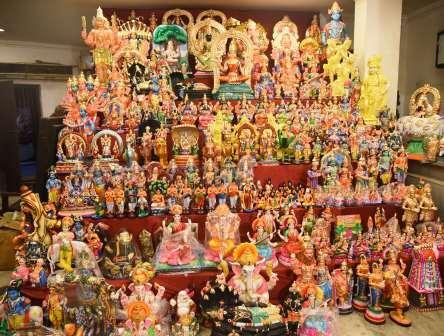 In South India Navarātri is celebrated having a Kolu where beautifully decorated dolls of all forms of Īsvara’s creation; purāṇa characters, animals, trees, birds, flowers, and so on, are arranged on steps (5,7,9 steps). Women and children dressed in traditional clothes visit each other’s kolus. The speciality of this festive season is that women and children are honoured as Devī with turmeric, kumkum, betel leaves, nuts, coconut, flowers, sweets and ‘ sundal ’ (prepared with peas, chickpeas etc.). In most temples, especially Devī temples, Navarātri is grandly celebrated with music concerts, cultural dances and spiritual discourses.
In West Bengal it is called Durgā Pūjā and is observed for 5 days. It is a public festival, where the whole country comes alive. Huge mūrtis of Durgā Mā killing Mahiṣāsura are set up and people throng the pūjā pandals filled with religious fervour.
In the North, the festival is observed as Śrī Rāma’s triumphant entry into Ayodhyā after killing the asura Rāvaṇa. On Vijayādaśamī day huge effigies of Rāvaṇa, his brother Khumbhakarṇa and son Indrajit are burnt on public grounds to the great joy of people.
In Gujarat women dressed in colourful attire sing and dance playing dāndiyās (colourful wooden sticks) and in some places they fly kites. All over India many observe fast during these nine days breaking it on Vijayādaśamī.
Let us pray to the three Devīs, Kāli Mā, Śrī Mahālakṣmī, Sarasvatī Mā, to remove our impurities and ignorance to realize our svarūpam.
By Dr. Amritha Murthy